Wall Street Storms Ripple In Explosive $500 Million Deal

bitcoinistОпубліковано о 2025-12-09Востаннє оновлено о 2025-12-09

Анотація

Ripple secured a $500 million investment from major Wall Street firms, including Citadel Securities and Fortress Investment Group, lifting its valuation to approximately $40 billion. A key feature of the deal is the significant downside protection for investors, including a put option allowing them to sell shares back to Ripple after 3-4 years for a guaranteed 10% annualized return unless the company goes public. In return, Ripple can only force a buyback by paying about 25% annually. Investors also received liquidation preference. The deal is largely viewed as a concentrated bet on XRP, with an estimated 90% of Ripple's net asset value tied to the cryptocurrency. This structure is now become a new reference point for assessing crypto credit risk, pressuring Ripple to pursue an IPO or find new liquidity before the put windows open.

Ripple has become the most aggressively structured bet in blue-chip crypto after a group of major Wall Street firms wired about $500 million into the company in November, lifting its valuation to roughly $40 billion and making it one of the highest-valued private players in the sector. Bloomberg reported that Ripple’s share sale brought in some of the biggest names of Wall Street but only after investors secured a suite of downside protections.

Wall Street Goes All-In On Ripple

The investor line-up reads like a who’s who of modern market structure: Citadel Securities, Fortress Investment Group, Marshall Wace, Brevan Howard–linked vehicles, Galaxy Digital and Pantera Capital all participated, treating the round at least as much as a structured credit trade as a venture bet.

According to multiple accounts of the deal, several funds underwrote Ripple essentially as a concentrated exposure to XRP itself. Bloomberg’s reporting states that multiple investors concluded at least 90% of Ripple’s net asset value was tied to XRP, with the company controlling about $124 billion of the token at market prices in July.

That XRP cushion has already been tested. XRP is down roughly 40% from its mid-July peak and about 15–16% since late October, yet even after that drawdown, estimates in deal coverage still put the company’s XRP treasury in the tens of billions of dollars, with a large portion locked in escrow and released gradually over time.

The protection that Wall Street insisted on has become the defining feature of the deal. Investors secured the right to sell their shares back to Ripple after three or four years at a guaranteed 10% annualized return, unless the company has gone public by then.

Ripple, conversely, can force a buyback in those same windows only by delivering about 25% annually. On top of that, the funds negotiated a liquidation preference, giving them priority over legacy shareholders in a sale or insolvency.

The numbers involved are non-trivial. FinTech Weekly estimates that if the put option were exercised in full at the four-year mark, Ripple’s cash outlay would approach $700 million–$730 million, irrespective of operating performance or token prices at the time. Those obligations sit alongside an already heavy capital agenda: Ripple has agreed to buy prime-brokerage platform Hidden Road for roughly $1.3 billion and corporate-treasury specialist GTreasury for about $1 billion, while also confirming it has repurchased more than 25% of its outstanding shares.

Banks and trading desks are now treating the November round as a new reference point for crypto credit risk. FinTech Weekly reports that “those terms are now shaping how banks, funds, and trading desks assess Ripple’s balance sheet, exit risk, and future liquidity,” with the three- and four-year exit windows being modeled explicitly alongside XRP price scenarios and rate curves.

Ripple’s management maintains there is “no plan, no timeline” for an IPO, but the structure of the deal effectively date-stamps its private capital: either the company lists or finds new liquidity on favorable terms before the put windows open, or it must fund a secured, fixed-return exit for some of the most sophisticated players on Wall Street.

At press time, XRP traded at $2.0498.
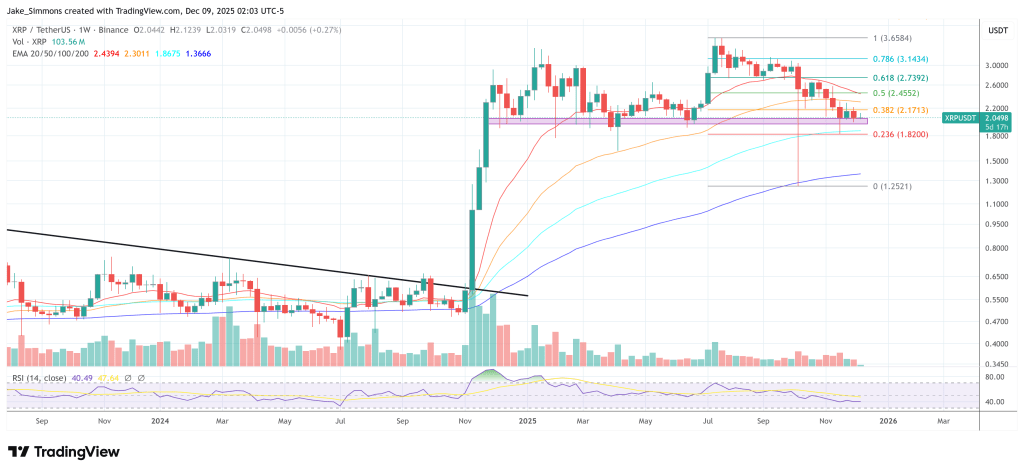
XRP holds above key support, 1-week chart | Source: XRPUSDT on TradingView.com

Пов'язані матеріали

Everyone is MicroStrategy: When JPMorgan Starts Accepting BTC as Collateral, Will You Still Sell Your Coins?

The article discusses a major shift on Wall Street, where major banks like JPMorgan, Citi, and Bank of America have reportedly begun accepting Bitcoin as collateral for cash loans. This move, revealed by MicroStrategy's Michael Saylor, signifies Bitcoin's evolution into a "pristine collateral" asset, comparable to U.S. Treasuries or gold. It allows holders to access liquidity without selling their Bitcoin, avoiding capital gains taxes and maintaining exposure to potential price appreciation. This development effectively democratizes the "Buy, Borrow, Die" strategy previously accessible only to large institutions and the ultra-wealthy. It is framed as a critical step in Bitcoin's monetary evolution, enabling credit creation. A "credit flywheel" is described: rising BTC prices increase collateral value, allowing for larger loans, which can be used to purchase more assets, potentially driving prices higher. This shift also suggests a weakening of restrictive regulations like the SEC's SAB 121, transferring power from crypto-native exchanges to traditional financial institutions. The article concludes with a warning about the risks of leverage, as price drops could trigger mass, forced liquidations. It offers advice for investors: adopt a "debt mindset" to use loans for expenses while holding assets, cautiously manage loan-to-value ratios to avoid margin calls, and watch for a resurgence of regulated, compliant CeFi platforms.

marsbit13 хв тому

Everyone is MicroStrategy: When JPMorgan Starts Accepting BTC as Collateral, Will You Still Sell Your Coins?

marsbit13 хв тому

Bitcoin Returns Above $94,000: Is the BTC Bull Market Restarting?

Bitcoin has reclaimed the $94,000 level, signaling a potential for renewed bullish momentum after a period of consolidation. The price broke through the $93,500 resistance, strengthening the short-term upward structure. However, underlying liquidity indicators remain a concern, as trading volume and market depth have not yet shown strong confirmation of sustained buying interest. Market focus is on whether bulls can provide the necessary momentum to continue the rally, especially with the upcoming FOMC meeting influencing broader market sentiment. Despite the price recovery, the buy-sell ratio and liquidity metrics indicate cautious and gradual entry by buyers rather than aggressive accumulation. Analysts note that while price action is driving the breakout, new demand is only slowly emerging. Key observations include the absorption of the FVG (Fair Value Gap) between $87,500 and $90,000, though the move lacked follow-through initially. The market must hold above the monthly VWAP to confirm a trend reversal. Additionally, pricing溢价 data from exchanges like those in Korea and Coinbase show mixed signals, with retail enthusiasm cooling and institutional interest yet to fully commit. The article concludes that while Bitcoin shows strength, the sustainability of this rally depends on stronger liquidity support and broader market participation.

cointelegraph_中文19 хв тому

Bitcoin Returns Above $94,000: Is the BTC Bull Market Restarting?

cointelegraph_中文19 хв тому

Торгівля

Спот
Ф'ючерси
活动图片